
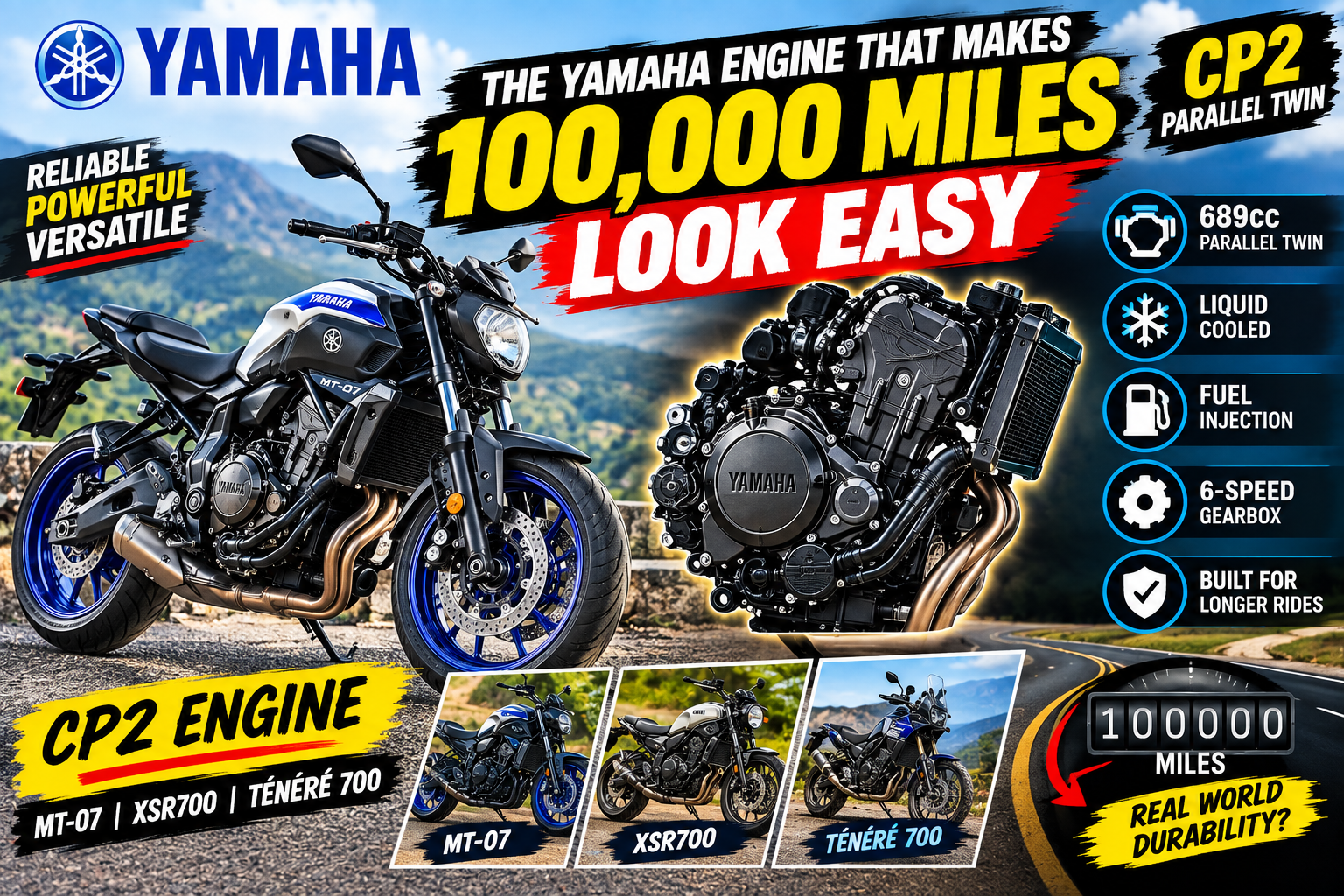
Yamaha has built a strong reputation for producing motorcycles that combine engaging performance, practical engineering, and long-term dependability. Among its modern powerplants, one engine family has attracted particular attention from riders: the Yamaha CP2 parallel-twin.
Used in motorcycles such as the Yamaha MT-07, XSR700, and Ténéré 700, the 689cc CP2 engine is known for its distinctive character, flexible power delivery, and versatility. It has also demonstrated its durability in demanding real-world conditions, making it an interesting choice for riders who want a motorcycle capable of accumulating serious mileage.
But what makes this engine special, and can it really make 100,000 miles look easy?
Yamaha CP2 Engine: What Makes It Special?

The Yamaha CP2 is a 689cc, liquid-cooled, four-stroke, parallel-twin engine. Its crossplane-inspired crankshaft design helps give it a distinctive firing character and an engaging exhaust note.
Rather than focusing exclusively on peak horsepower, Yamaha developed the engine to deliver useful torque across the rev range. This makes it suitable for everyday commuting, spirited riding, touring, and adventure motorcycling.
The CP2 engine’s key characteristics include:
- 689cc parallel-twin configuration
- Liquid cooling
- Four-stroke, DOHC design
- Crossplane-concept 270-degree crankshaft
- Strong low- and mid-range performance
- Fuel injection
- Six-speed transmission in its motorcycle applications
The exact output and equipment vary depending on the motorcycle and model year.
The Yamaha Ténéré 700: A Real-World Durability Example

One of the most interesting demonstrations of CP2 durability comes from the Yamaha Ténéré 700.
A Yamaha Motor New Zealand feature documented a Ténéré 700 operated by adventure-riding business RideADV. The motorcycle had covered more than 100,000 kilometres, much of it on demanding off-road routes.
That is approximately 62,000 miles, not 100,000 miles. Nevertheless, the example provides a useful look at how the CP2 engine can perform under sustained real-world use.
The motorcycle had been used for adventure rides, testing, and everyday operational duties. During an inspection at around 80,000 kilometres, the engine’s camshafts and related valve-train components were reported to be in very good condition.
The bike’s history illustrates how a well-engineered engine, appropriate maintenance, and consistent servicing can contribute to long-term durability.
It is important to remember that one high-mileage example does not establish a guaranteed lifespan for every CP2-powered motorcycle.
Why the CP2 Engine Has a Reputation for Reliability
1. A Practical Parallel-Twin Design
The CP2 uses a relatively straightforward two-cylinder configuration rather than a complicated high-cylinder-count layout.
Its design provides a balance between performance, packaging, and everyday usability. The engine is compact enough for different motorcycle categories while delivering the power required for highway riding and touring.
Fewer cylinders do not automatically guarantee greater reliability, but a well-developed engine with appropriate servicing can offer a practical long-term ownership experience.
2. Strong Mid-Range Torque
The CP2 engine delivers accessible torque that makes it enjoyable in ordinary riding conditions.
Riders do not need to keep the engine at extremely high revolutions to access useful acceleration. This flexibility can make city riding, overtaking, and long-distance journeys more comfortable.
Its broad power delivery is one reason the engine works well in motorcycles with very different purposes.
3. Liquid Cooling and Modern Fuel Injection
Liquid cooling helps the engine maintain a controlled operating temperature, while electronic fuel injection manages fuel delivery according to operating conditions.
These systems help provide consistent performance and efficient combustion.
However, the cooling system must be maintained properly. Coolant condition, radiator cleanliness, hoses, and the cooling fan all deserve attention, especially on motorcycles regularly used in hot weather or slow-moving traffic.
4. An Engine Designed for Multiple Applications
Yamaha uses the CP2 platform across several motorcycle categories.
The MT-07 focuses on accessible street performance, the XSR700 combines the engine with retro-inspired styling, and the Ténéré 700 adapts it for adventure riding.
This broad application demonstrates the engine’s versatility. It also means that service requirements, engine tuning, and supporting components should always be checked for the particular model.
Which Yamaha Motorcycles Use the CP2 Engine?

Yamaha MT-07
The MT-07 is a middleweight naked motorcycle that combines the CP2 engine with an upright riding position and agile handling.

Yamaha XSR700
The XSR700 pairs the same engine family with retro styling and everyday road-bike practicality.

Yamaha Ténéré 700
The adventure-focused Ténéré 700 uses the CP2 platform for touring and off-road exploration.
These motorcycles demonstrate how one engine platform can serve different riding styles without losing its fundamental character.
Can a Yamaha CP2 Engine Really Last 100,000 Miles?
A motorcycle engine reaching 100,000 miles is a significant achievement. The CP2’s reputation and high-mileage examples make that an interesting possibility, but there is no universal mileage figure that every owner should expect.
Reaching 100,000 miles would depend on several factors:
- Following the manufacturer’s oil-change schedule
- Using the specified engine oil
- Inspecting valve clearances at the recommended intervals
- Maintaining the cooling system
- Keeping the air filter clean
- Avoiding prolonged overheating
- Addressing unusual engine noises or oil consumption promptly
- Maintaining the clutch, transmission, and drivetrain
High-mileage motorcycles may also require replacement of wear items and supporting components. Suspension parts, wheel bearings, seals, chains, sprockets, and clutch components can need attention long before the engine reaches the end of its useful life.
A motorcycle that has covered 100,000 miles may therefore have undergone substantial maintenance even if its original engine remains in service.
Maintenance: The Key to Long Engine Life
The CP2 is not maintenance-free. Owners should follow the service schedule specified for their motorcycle, including oil and filter changes, valve-clearance inspections, spark-plug replacement, and cooling-system checks.
Adventure motorcycles may require additional attention because dust, water crossings, rough terrain, and heavy loads can place extra demands on components.
For riders who cover high annual mileage, keeping accurate service records is especially valuable. Records help identify recurring issues, establish when components were replaced, and support the motorcycle’s resale value.
Yamaha CP2 vs High-Performance Motorcycle Engines
The CP2 takes a different approach from high-revving supersport engines.
|
Feature
|
Yamaha CP2
|
High-performance supersport engine
|
| — | — | — |
|
Main focus
|
Usable everyday performance
|
High-speed performance
|
|
Power delivery
|
Strong, accessible mid-range
|
Often emphasizes high-rpm power
|
|
Riding applications
|
Street, retro, adventure
|
Primarily sporty road and track use
|
|
Maintenance
|
Model-specific scheduled servicing
|
Model-specific scheduled servicing
|
|
Long-term lifespan
|
Depends on use and maintenance
|
Depends on use and maintenance
|
This is a broad comparison rather than a statement that one engine category is inherently more reliable. Individual engine designs, maintenance histories, and riding conditions matter considerably.
Frequently Asked Questions (FAQs)
1. Which Yamaha engine is known for high-mileage durability?
The 689cc CP2 parallel-twin is one of Yamaha’s well-known modern motorcycle engines. Its use in the MT-07, XSR700, and Ténéré 700 has made it popular among riders looking for a versatile middleweight powerplant.
2. Can a Yamaha CP2 engine last 100,000 miles?
It is possible for a well-maintained motorcycle engine to accumulate very high mileage, but 100,000 miles should not be treated as a guaranteed CP2 lifespan. Riding conditions, maintenance, and individual engine condition all matter.
3. Which Yamaha motorcycle is best for long-distance riding?
The Ténéré 700 is designed for adventure touring, while the MT-07 and XSR700 are primarily road-oriented motorcycles. The right choice depends on riding position, luggage needs, road conditions, and personal preferences.
4. Is the Yamaha CP2 engine expensive to maintain?
Maintenance costs depend on the motorcycle, local labour rates, parts prices, and service history. Routine servicing is essential, and owners should budget for periodic inspections and wear-item replacement.
5. What is the difference between 100,000 kilometres and 100,000 miles?
100,000 kilometres is approximately 62,137 miles. In comparison, 100,000 miles is approximately 160,934 kilometres.
Final Verdict
The Yamaha CP2 is a compelling example of a modern motorcycle engine designed to balance performance, versatility, and everyday usability. Its 689cc parallel-twin configuration powers everything from the MT-07 roadster to the adventure-ready Ténéré 700.
Real-world high-mileage examples demonstrate the potential for impressive durability, particularly when motorcycles receive appropriate maintenance. However, the documented Ténéré 700 example that exceeded 100,000 kilometres had covered roughly 62,000 miles, so it should not be presented as proof of a 100,000-mile engine.
For riders considering a Yamaha for years of commuting, touring, or adventure riding, the CP2 is an engine worth understanding. Its combination of accessible performance and proven real-world use explains why it continues to attract attention among motorcycle enthusiasts.